Read the conclusions of our Policy Expert Discussion here
29 January 2026 | Thursday Talks Webinar Series
On 29 January 2026, the BIOEAST HUB CR, in cooperation with the BioRefine Cluster, hosted an online Policy Expert Discussion dedicated to freshwater within the evolving EU bioeconomy framework. The event gathered representatives of the EU Mission “Restore Our Ocean and Waters by 2030,” European Commission services, macro-regional initiatives, research consortia, and investment platforms to explore how freshwater systems must be systematically integrated into Europe’s new bioeconomy governance architecture.
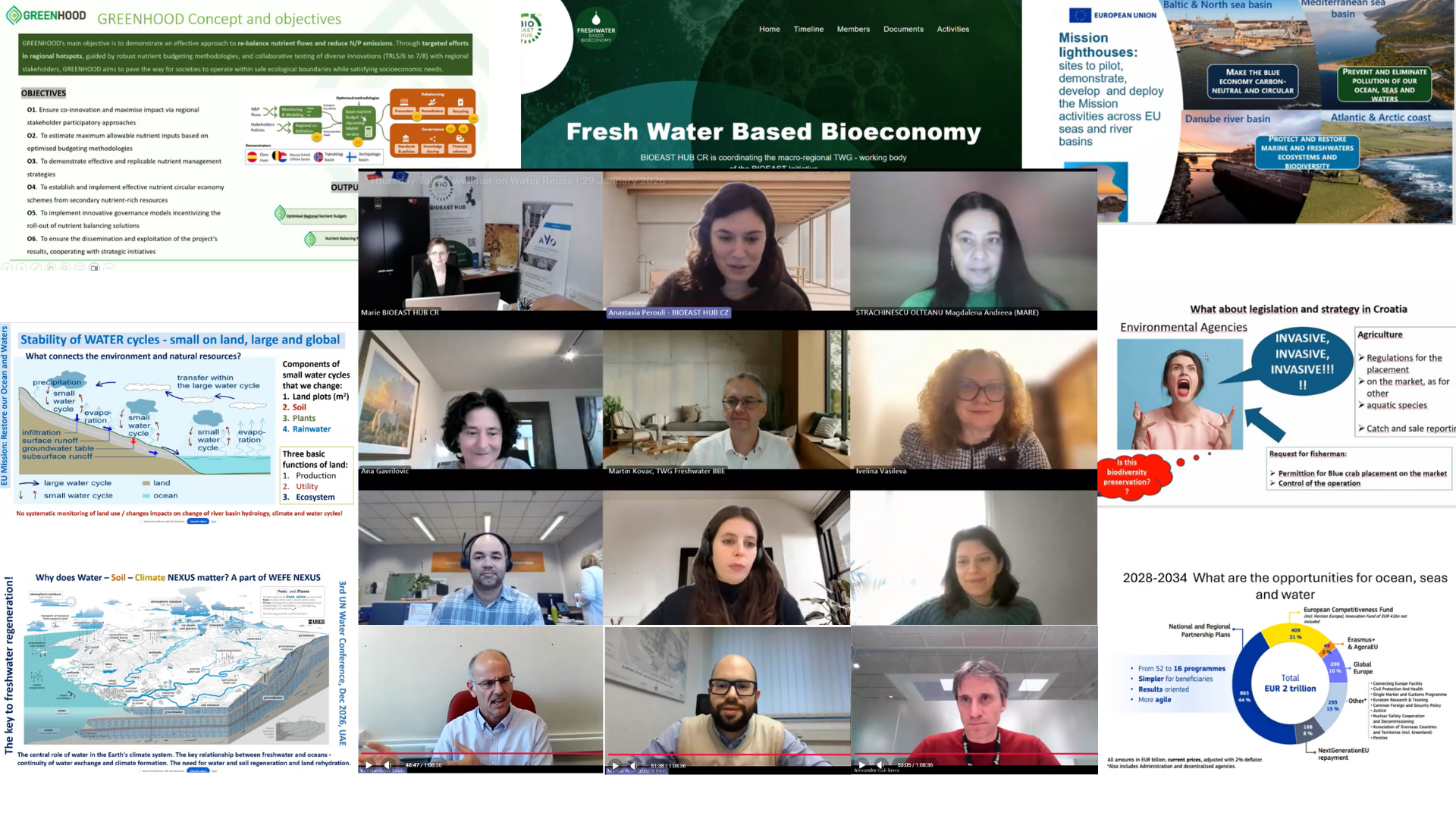
The discussion was framed by the recognition that Europe’s climate resilience, food security, biodiversity protection, and industrial competitiveness are deeply dependent on functional water cycles and healthy soils. Despite growing political momentum around the European Ocean Act and the new EU Bioeconomy Strategy, freshwater systems—rivers, lakes, groundwater, and soil moisture—remain insufficiently embedded in cross-sectoral governance.
Ivelina Vasileva, Member of the Board of the EU Mission “Restore Our Ocean and Waters,” highlighted the need to move beyond sectoral coordination toward fully integrated water-to-ocean governance, emphasizing that Europe’s rivers, coasts, and seas are parts of one systemic challenge.
Magdalena Andreea Strachinescu Olteanu, Head of Unit for Maritime Innovation, Knowledge and Investment (DG MARE), emphasized that innovation only matters if it reaches the market, calling for stronger investment frameworks, financing instruments, and investor readiness to support a competitive blue—and freshwater—economy.
Ana Gavrilović, Member of the Board of the EU Mission “Restore Our Ocean and Waters,” pointed out that freshwater aquaculture remains under-recognized in policy frameworks despite being a major component of European aquaculture, and called for its stronger integration into EU strategies.
Marie Kubankova, Coordinator of the BIOEAST TWG Freshwater BBE and BIOEAST HUB CR, presented the updated Thematic Strategic Research and Innovation Agenda key principles focused on freshwater and underlined that integrating the Water–Soil–Climate Nexus into EU bioeconomy governance is essential for the resilience and competitiveness of the BIOEAST macro-region.
Martin Kováč, Member of the BIOEAST TWG Freshwater BBE and advocate of the Water–Soil–Climate Nexus, stressed that what happens on land directly shapes hydrology and climate stability, arguing that restoring small water cycles and implementing local water planning are fundamental to making EU strategies effective.
Kostas Soulis, Coordinator of the Path4Med project, demonstrated how Earth observation, sensors, artificial intelligence, and digital twins can trace nutrient flows across the soil–river–sea continuum, providing policymakers with actionable, evidence-based tools.
Marton Pesel, DALIA & EUSDR Projects Coordinator, presented the EU Strategy for the Danube Region as a model for transboundary cooperation, showing how macro-regional platforms can connect local action with European policy objectives.
Alexandre Galí Serra, representing the GreenHOOD project, showcased how nutrient circularity, co-innovation with regional stakeholders, and ecosystem restoration can rebalance nitrogen and phosphorus flows while supporting rural bioeconomy development.
Across all contributions, a shared message emerged: freshwater, soil, climate, and ocean policies cannot be addressed in isolation. The “source-to-sea” perspective requires governance frameworks that recognize hydrological interdependencies from local land use to marine ecosystems.
The Water–Soil–Climate Nexus—developed within the BIOEAST Thematic SRIA—was positioned as a systemic solution that connects land management, hydrology, and climate regulation, promotes decentralized water retention and soil rehydration, supports regenerative agriculture and circular aquaculture, encourages community-based local water planning and lastly aligns research, policy, and finance instruments
Speakers stressed that Europe must now move decisively from strategic declarations to operational implementation, leveraging mature technologies, stakeholder engagement, and coherent financing frameworks.
The Policy Expert Discussion reaffirmed that freshwater is not a sectoral issue but a structural pillar of Europe’s circular, regenerative, and competitive bioeconomy.
The Water–Soil–Climate Nexus, as articulated by the BIOEAST Thematic Working Group and reinforced by Mission Board members, Commission representatives, and project coordinators, offers an integrated, science-based, and community-driven framework to address climate risks, biodiversity loss, water scarcity, and land degradation simultaneously.
By embedding freshwater priorities into the evolving European Bioeconomy Strategy and the forthcoming European Ocean Act, Europe can transform water, soil, and climate systems into active drivers of sustainability, territorial cohesion, rural vitality, and long-term competitiveness.
The BIOEAST macro-region and the Danube River basin are uniquely positioned to serve as a model for integrated freshwater governance—demonstrating how cross-border cooperation, innovation deployment, and ecosystem-based solutions can strengthen Europe’s resilience in an era of rising climate challenges.